
A topical nail-care label answers several different questions: what the product is, where it is meant to go, how it is used, and which warnings apply. Reading those answers in order is more useful than hunting for a single familiar ingredient. This guide uses a general label-reading method; it does not reproduce an unverified KeraFirm package.
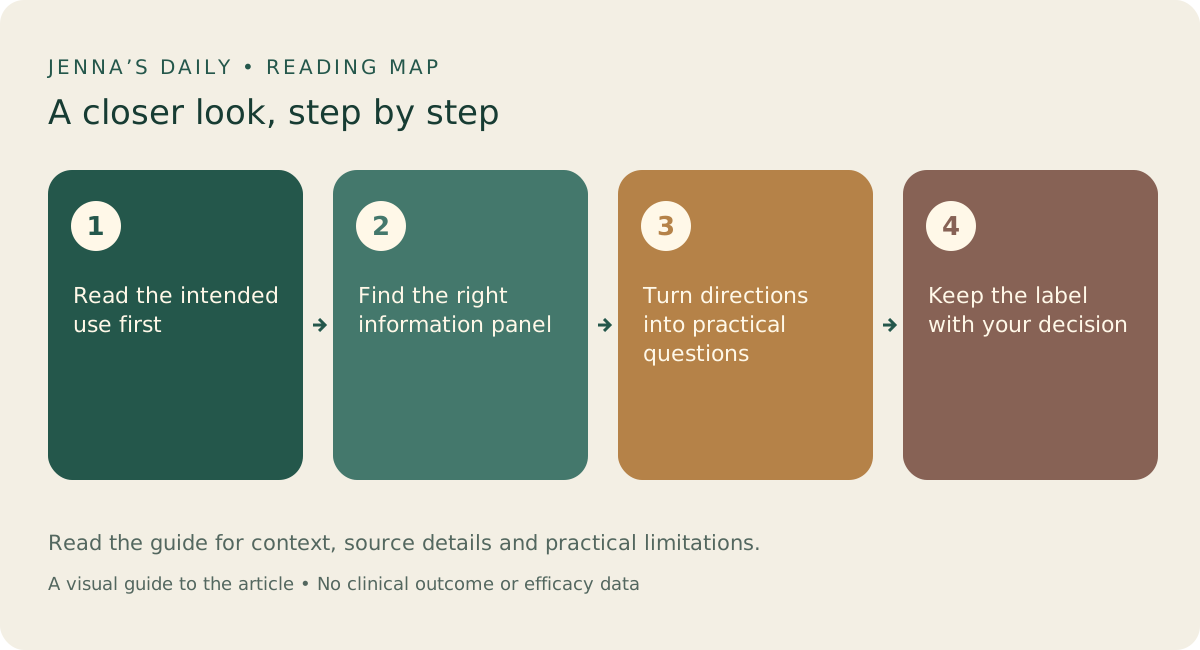
Read the intended use first
Start with the words that describe what the product is for. FDA explains that intended use helps determine whether something is a cosmetic, a drug, or both. A polish or moisturizer and a product intended to treat disease are not interchangeable categories simply because each comes in a small bottle.
Write the stated purpose in your own notes, then compare it with the claim that brought you to the page. If an advertisement suggests an infection treatment while the package describes appearance care, that mismatch needs an answer. Do not resolve it by assuming that a familiar botanical has the same role in every formulation.
Find the right information panel
Read the complete ingredient information and any directions or warnings. A drug label may use a Drug Facts panel, while a cosmetic has different labeling requirements. Do not expect every topical product to have an active-ingredient percentage, and do not invent one when it is absent. Product category and package information should guide the reading.
Make a short record of what is visible and what is missing. If a photo cuts off a warning, request a complete image. Small print can contain the information that determines whether the product is relevant to your question. A glossy front label is not a substitute for those details.
| Check | Record | Why it helps |
|---|---|---|
| Purpose | Exact intended-use wording | Choose the correct category |
| Directions | Site and frequency as printed | Avoid borrowing another label |
| Warnings | Full panel, not a crop | Identify unanswered questions |
Turn directions into practical questions
Check the application site, frequency, storage, and any instructions about avoiding particular areas. If directions are unclear, ask the seller or a pharmacist before using the product. Do not transfer instructions from another brand just because both are called oils or solutions. This article does not recommend a personal application schedule.
Imagine where you would keep the product and how you would follow its directions on an ordinary day. Is the applicator usable for you? Can the package be closed securely? Practical fit is a reasonable comparison point, but it should not become a claim that the product works better medically.
Keep the label with your decision
Save a dated label image and the seller identity if you decide to buy. Check the delivered package against the information used for your decision. If the version differs, contact the seller rather than assuming the change is trivial. A repeat order is also a chance to check the package again.
KeraFirm’s current complete label has not been verified here. No ingredient, treatment purpose, or application frequency is assigned to that brand here. The useful next step is a complete label, followed by a comparison of directions and warnings with your actual needs. A concerning nail change belongs in a conversation with a qualified professional.
A quick label-reading exercise
Imagine a front panel saying nail appearance care while a review calls the same item an infection cure. You do not need to decide its legal category yourself to recognize the conflict. Ask for the complete label and clarification of the intended use. Keep the review’s interpretation separate from the actual package wording.
Sources & further reading
Manufacturer information, when cited, is a commercial source. It does not establish that a finished product is clinically effective.