
Bemotrizinol is a sunscreen active ingredient newly added to the US over-the-counter sunscreen monograph in 2026. That change expands the permitted ingredient options under specific conditions. For someone reading a sunscreen label, the useful question is what the update means for the product in front of them—not whether a new ingredient makes the rest of sun protection unnecessary.
What changed in 2026?
The FDA announced the action in a June 9 news release. Its regulatory record dates the final administrative order June 10, with an effective date of August 9, 2026. Those dates describe different steps, so an older article about a proposal may no longer describe the current position.
The order permits bemotrizinol at concentrations up to 6% under its specified conditions. The FDA describes it as providing protection against both UVA and UVB radiation and considers its use generally recognized as safe and effective under those conditions for adults and children six months and older.
| Date in 2026 | What it refers to |
|---|---|
| June 9 | FDA news announcement |
| June 10 | Formal final administrative order |
| August 9 | Order’s stated effective date |
An ingredient decision is one part of a product
An OTC monograph sets conditions a qualifying nonprescription drug must meet. It is different from a separate approved drug application for each finished product. A label containing the new ingredient does not mean every promise surrounding that product has been individually endorsed by the FDA.
Compare the full product information: active ingredients, SPF, broad-spectrum wording, directions, water-resistance statements and warnings. The ingredient name alone does not tell you the product’s complete performance, how it feels on your skin, or whether you will use it as directed. There is no need to turn a regulatory update into a claim that one ingredient is right for everyone.
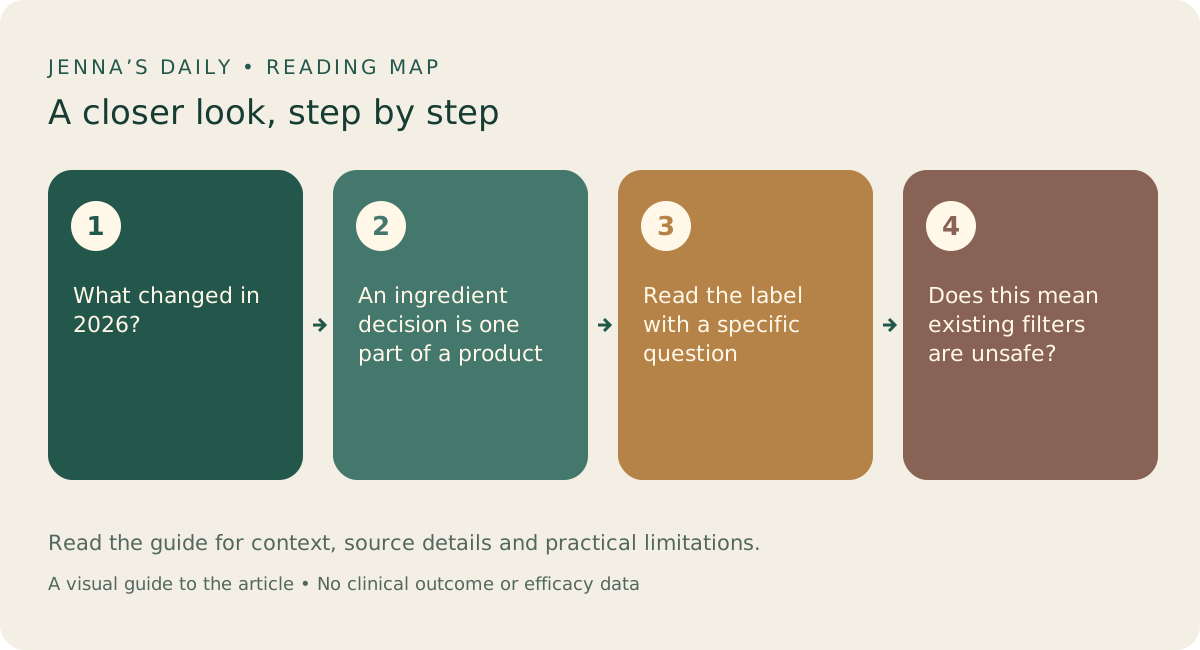
Read the label with a specific question
Start with the job you need the sunscreen to do. For example, a person choosing something for outdoor swimming has a different practical question from someone comparing the texture of two everyday products. Keep any water-resistance claim and reapplication instructions with the product you are considering.
- Find the complete Drug Facts information, rather than relying on a front-label slogan.
- Check the actual SPF and broad-spectrum statement.
- Read the directions and warnings for that particular product.
- Treat price and package size as separate questions from protection claims.
A useful comparison note has one row per product and a separate field for each of those questions. Leave a field blank when the listing does not answer it, then look for the current package. Do not complete an unclear label from a similar-looking tube or another country’s version.
Does this mean existing filters are unsafe?
No. The FDA’s sunscreen questions-and-answers page explains that requesting more safety data for certain other ingredients is not a conclusion that those ingredients are unsafe. Avoid replacing that careful distinction with a social-media safe-versus-toxic list.
The FDA continues to advise combining sunscreen with other sun-protection measures, including limiting exposure and using protective clothing. A new ingredient does not remove the need to follow the package directions. If a product causes a reaction or you need help choosing protection for your circumstances, ask a qualified health professional.
Sources & further reading
- FDA Expands Sunscreen Options for the First Time in 20 Years ↗
- FDA regulatory actions on over-the-counter sunscreen: questions and answers ↗
- Final Administrative Order OTC000039 ↗
- Sunscreen: How to Help Protect Your Skin from the Sun ↗
Manufacturer information, when cited, is a commercial source. It does not establish that a finished product is clinically effective.