
An oral supplement can list a mineral, its chemical form, a weight, and a percent Daily Value in a small space. Each field has a different job. Reading them separately makes comparisons clearer and prevents a large number from becoming a recommendation. This guide explains label quantities; it does not diagnose a deficiency or choose a dose.
Start with the declared nutrient amount
Find the mineral’s own line and the serving size. NIH explains, for calcium, that the Supplement Facts panel lists elemental calcium rather than asking consumers to calculate it from the weight of the calcium compound. The compound name may appear as the source, but its total mass is a different concept.
If a marketing page highlights a compound weight while the panel declares a nutrient amount, keep both labels attached to their numbers. Do not select the larger figure as the amount of mineral provided. Ask for the complete panel if a cropped image prevents you from seeing which number belongs to which field.
Keep milligrams and micrograms distinct
One milligram equals 1,000 micrograms. A conversion can help compare the same nutrient in two products, but only after you confirm the unit and serving basis. Do not compare a bottle total with a serving amount or a source-compound weight with a declared nutrient amount.
For an arithmetic-only example, 0.5 milligrams equals 500 micrograms. That equality says nothing about an appropriate intake, the amount in OxyDental, or an expected dental result. Keep hypothetical examples visibly separate from product facts so that an educational table does not accidentally become a dose suggestion.
| Check | Record | Why it helps |
|---|---|---|
| Nutrient | Declared amount per serving | Distinguish source compound |
| Unit | mg or mcg exactly as printed | Convert only like quantities |
| Daily Value | Label reference percentage | Do not diagnose a personal need |
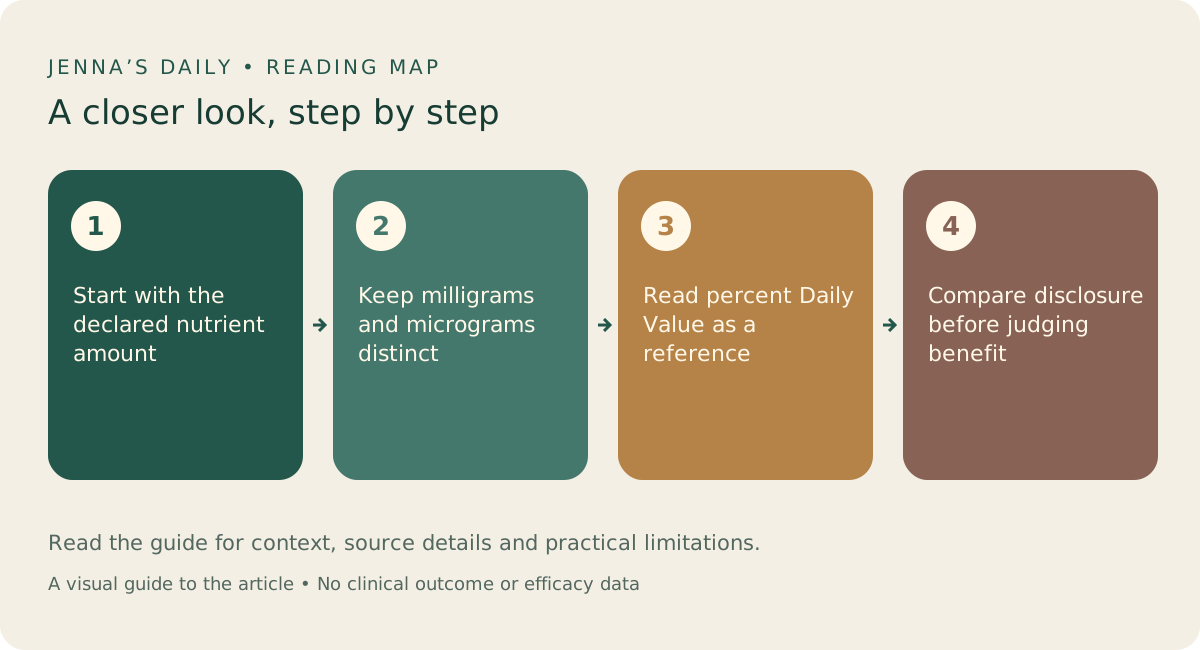
Read percent Daily Value as a reference
The percent Daily Value is a labeling reference, not a diagnosis of your needs. It does not account for every individual circumstance, food source, medicine, or other supplement. A higher percentage is not automatically a reason to choose a product, and a lower percentage is not evidence of a deficiency.
Write down other products you already use when asking a clinician or pharmacist about a mineral supplement. The exact label is more useful than a general statement that you take an oral-health product. This guide does not calculate a personal total or recommend combining products to reach a number.
Compare disclosure before judging benefit
A useful side-by-side table can show which mineral amounts are clearly declared per serving and which fields remain unknown. That is an information comparison. To assess a specific oral-health claim, you would need relevant evidence beyond the presence of a nutrient whose name appears in a dental context.
OxyDental’s current full mineral panel has not been verified in our record. No nutrient amount or percent Daily Value is assigned to the brand here. Obtain the label before applying this reading method, and bring personal suitability questions to a professional who can consider your health history and existing products.
A two-column exercise
Put the exact package wording in one column and your interpretation in another. For example, an amount per serving belongs in the first; an assumption that you personally need that amount belongs in the second and requires a different discussion. This makes it easier to show a professional which part of your question comes from the label.
Sources & further reading
Manufacturer information, when cited, is a commercial source. It does not establish that a finished product is clinically effective.