
The oral-care aisle offers many optional products, but a useful routine starts with a few repeatable essentials. Put those steps in place before asking whether another product adds something specific. This guide translates general American Dental Association advice into a practical planning checklist. Your dentist may recommend a different plan for your needs.
Make brushing an ordinary part of the day
The ADA recommends brushing twice daily with a soft-bristled brush and fluoride toothpaste. It also advises replacing a toothbrush around every three or four months, or sooner when the bristles are worn. Those recommendations are more useful than choosing a brush solely by the color, packaging, or an influencer’s collection.
Choose two moments that fit your actual schedule and keep the supplies accessible. If holding a brush, reaching certain areas, or remembering the step is difficult, ask your dentist for practical options. A routine should accommodate a real person’s day rather than assume that every product and technique is equally manageable.
Give cleaning between teeth its own place
The ADA recommends daily cleaning between teeth. The appropriate tool can depend on your mouth and abilities, so ask for advice if floss or another method is difficult to use. Do not treat a shopping guide as proof that the most expensive device is necessary for you.
Use a simple reminder attached to an existing habit. Keep the tool where you will use it and check that you understand the method. If an area bleeds, hurts, or concerns you, discuss it with a dental professional instead of assuming that adding a supplement will explain or resolve the problem.
| Check | Record | Why it helps |
|---|---|---|
| Brushing | Two daily moments and supplies | Build a repeatable habit |
| Between teeth | A suitable tool and method | Address practical difficulties |
| Optional products | A specific reason and label | Avoid displacing essentials |
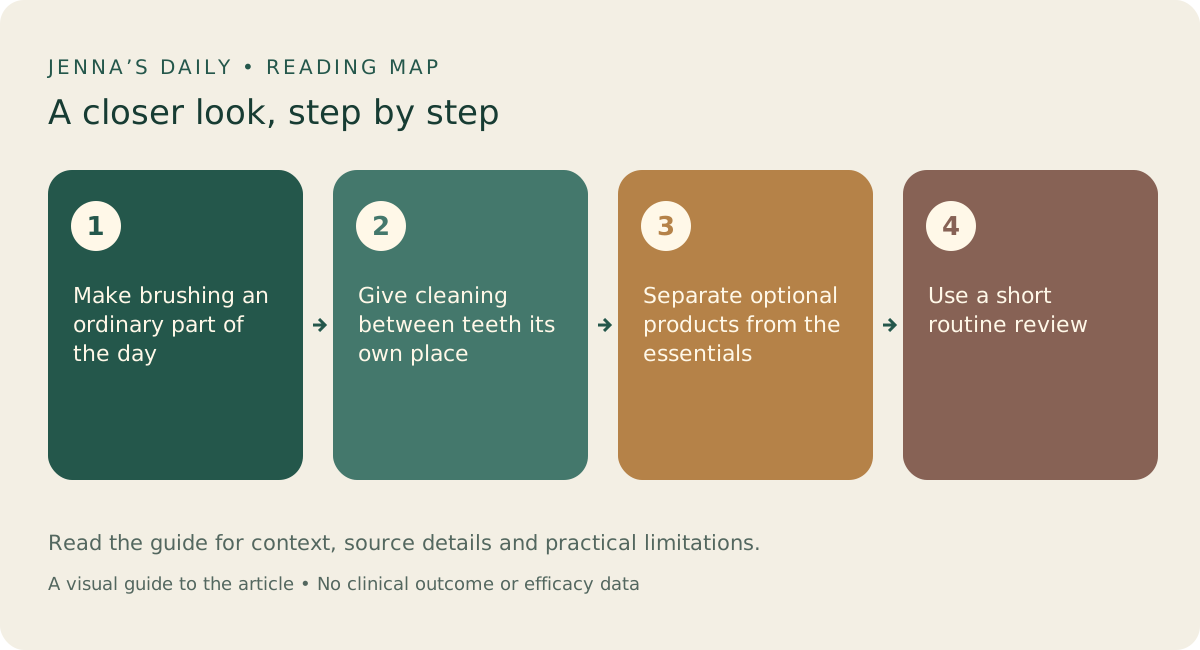
Separate optional products from the essentials
Before buying an extra product, write the specific question it is meant to answer. Is it a recommendation from your dentist, a convenience choice, or a claim from an advertisement? Those starting points deserve different follow-up. A general oral-wellness promise does not establish that a supplement belongs in every person’s routine.
Read the full current label, directions, and warnings for an optional product. Ask how it fits alongside your existing care and medicines where relevant. Do not replace fluoride toothpaste, cleaning between teeth, or a needed dental appointment with an oral supplement simply because its marketing uses familiar dental language.
Use a short routine review
At a normal restocking moment, check whether you have the basic supplies, whether the toothbrush is worn, and whether you have an unanswered question for the dentist. You do not need to track every brushing session in an app to make the routine useful. A simple list can be enough to identify what is getting in the way.
OxyDental is a candidate for a separate product guide, but its current full label and suitability have not been established here. No supplement is required by this checklist. If you want to discuss one, take the actual package to your dental professional and keep the basic routine in place while you consider the answer.
Keep the restocking list short
Write down the essentials you use, what is running low, and one question for your next dental visit. Leave space for the professional’s answer before adding a new optional product. This keeps shopping tied to a concrete routine and makes it easier to notice when an advertisement is asking you to solve a problem that has not been assessed.
Sources & further reading
Manufacturer information, when cited, is a commercial source. It does not establish that a finished product is clinically effective.