
A long ingredient list can feel like a complete explanation even when it leaves important quantities undisclosed. A multi-ingredient gut supplement needs to be read at two levels: what the label identifies, and what it lets you calculate. This guide focuses on that distinction rather than treating the number of ingredients as a score.
Separate names from quantities
Create two columns: ingredients named and amounts disclosed per serving. A name in the first column does not automatically belong in the second. The FDA labeling guide describes proprietary-blend declarations that include a total blend weight and component names without necessarily listing every component’s individual quantity.
That structure limits the conclusions available from a label. You may be able to identify that a component is included without knowing its amount. Do not divide the total blend weight equally among the listed components or use list length to estimate a dose. Those calculations would add information the label has not provided.
Read the whole panel before comparing
Check the serving size, blend name, total quantity, separately declared nutrients, and other ingredients. A large number on the front may refer to a total mixture, a serving, or something else. Copy its stated basis before comparing it with a second product. If the basis is unclear, place it in a questions column.
Use the same columns for both products even if one page is much more detailed. This makes the missing fields visible. A blank field does not prove that an ingredient is absent, nor does an attractive graphic prove that its amount is disclosed. A comparison should preserve those differences rather than smoothing them away.
| Check | Record | Why it helps |
|---|---|---|
| Named component | Whether it appears on the label | Identify inclusion only |
| Individual amount | Quantity and unit, if disclosed | Avoid dividing total blend weight |
| Evidence | Exact formula and outcome | Avoid ingredient-to-product leaps |
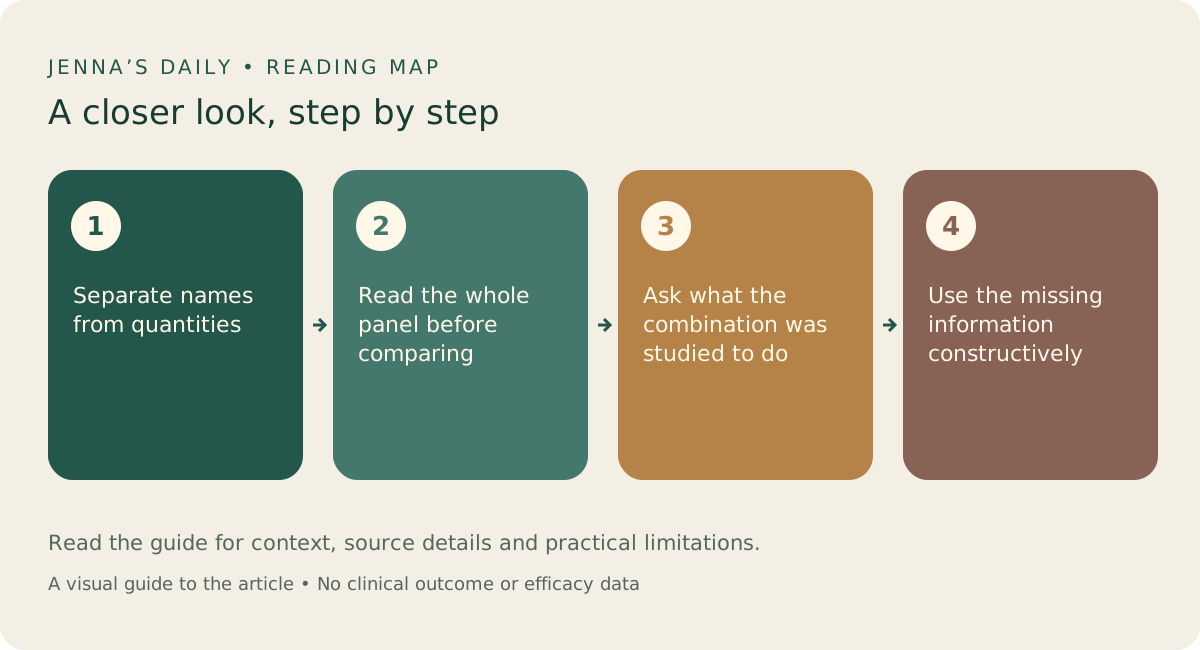
Ask what the combination was studied to do
A formula is more than a collection of ingredient names. Research on one component does not automatically establish the outcome of a mixture containing it. Look for a study on the finished formulation if the seller makes a specific finished-product claim, and check whether the formulation and instructions match the current product.
More components do not supply an automatic reason to expect a larger benefit. They can also make it harder to identify which information applies to a question you have. Our purpose here is to organize disclosure, not to recommend a complicated formula over a simple one or declare that one category is always preferable.
Use the missing information constructively
Ask the manufacturer for a current complete label and clarification of any quantities needed for your comparison. Bring that information to a pharmacist or clinician when you want help with medicines, overlapping products, or personal suitability. FDA advises discussing dietary supplements with a health professional rather than assuming that familiar or natural-sounding ingredients settle safety.
GutSave’s full current label has not been verified for this guide, so this guide does not assign it a proprietary blend, a particular dose, or a clinical result. Its commercial ingredient descriptions are a separate source from a package transcription. Keep the purchase question open until the information needed for your own decision is available.
A hypothetical blend example
Suppose a fictional label names three components under a 900-milligram blend. That total does not tell you that each contributes 300 milligrams. A comparison chart should show the blend total and leave individual amounts undisclosed unless the package supplies them. Clear empty cells are more useful than neat numbers created by an unsupported division.
Sources & further reading
Manufacturer information, when cited, is a commercial source. It does not establish that a finished product is clinically effective.