

When heartburn shows up as you get into bed, try to recall when you finished dinner and when you lay down. If a clinician has identified reflux, the time between those two events can be useful to check. Keeping a simple timeline can also give a clinician better information if your symptoms keep returning.
Take chest symptoms seriously
Start with the time you lie down
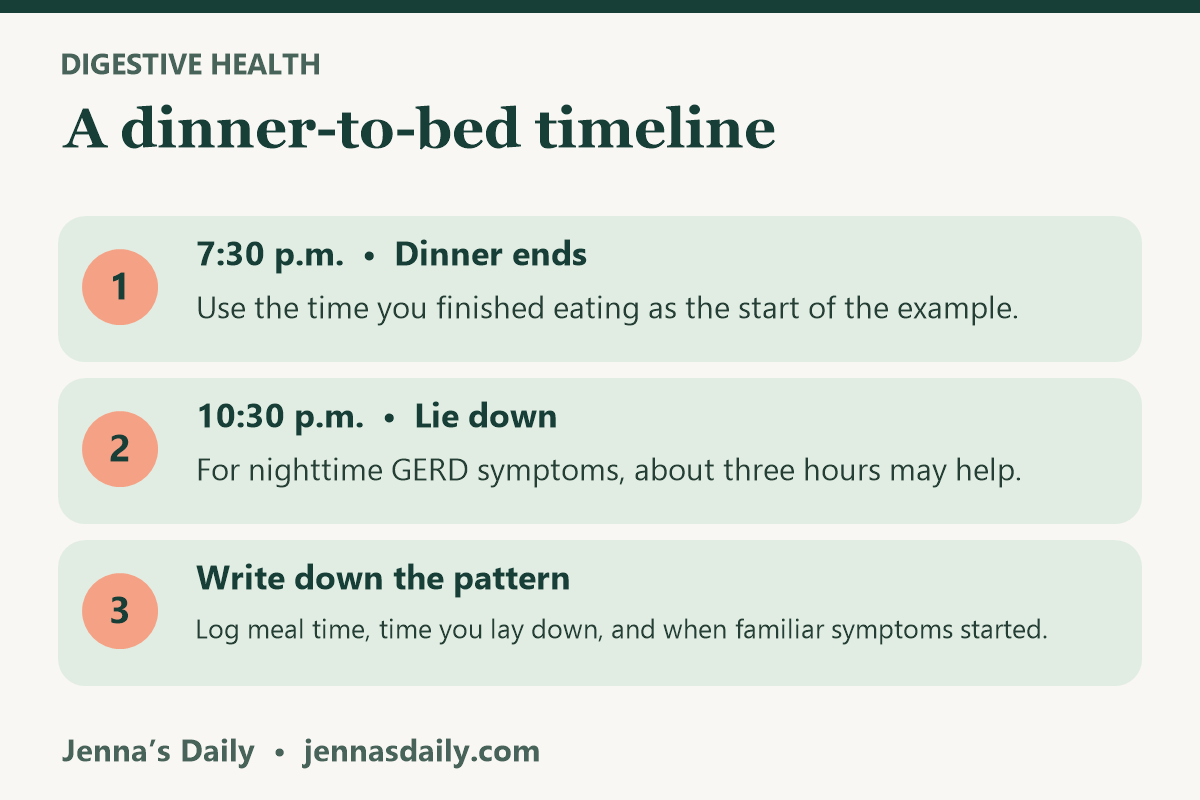
For people with GERD symptoms at night or when lying down, the NIDDK says leaving at least three hours between a meal and lying down may help. The American College of Gastroenterology also suggests avoiding meals within two to three hours of bedtime, a conditional recommendation based on limited evidence. It is a practical change to discuss when symptoms fit that pattern.
For a 10:30 p.m. bedtime, a three-hour gap means finishing dinner around 7:30 p.m. Use the time you actually lie down, including on the couch, rather than the time you get into bed. If your work or care schedule makes that gap difficult, tell your clinician.
Make a short log you can bring to a visit
Record the sequence on evenings when the symptoms are familiar and mild. Include symptom-free evenings too so you have something to compare. Use a few lines in a notebook.
| Write down | Example entry |
|---|---|
| When and what you ate | Finished dinner at 8:20 p.m. with pasta and a glass of wine. |
| When you lay down | Lay on the couch at 9:15 p.m. |
| What you noticed | Familiar burning sensation at 9:35 p.m. |
| How it changed | Recorded when it eased and whether it woke me later. |
Coffee, mint, alcohol, spicy foods, and acidic foods are examples of possible triggers, but patterns vary. One entry does not establish a trigger. Bring the notes to a visit so you can discuss what changes make sense for you.
Know when to seek care
Talk to a clinician if symptoms keep returning or do not improve with measures you have already tried. Seek prompt medical care for painful or difficult swallowing, ongoing vomiting, or unexplained weight loss. Seek immediate care for vomiting blood or material that looks like coffee grounds, or for black, tarry stools. Do not wait to finish a log if any of these symptoms occur.
A meal log supports a conversation and cannot diagnose GERD. Bring a list of any medicines you already take and ask your clinician or pharmacist before changing them.
Sources & further reading
- NIDDK: Eating, Diet, & Nutrition for GER & GERD ↗
- NIDDK: Symptoms & Causes of GER & GERD ↗
- NIDDK: Diagnosis of GER & GERD ↗
- American College of Gastroenterology: Clinical Guideline for Gastroesophageal Reflux Disease ↗
- American Heart Association: Warning Signs of a Heart Attack ↗
Manufacturer information, when cited, is a commercial source. It does not establish that a finished product is clinically effective.