Fibermaxxing is a social-media term for trying to eat more fiber, sometimes by pursuing very high daily totals. Stanford Medicine discussed the trend in June 2026, followed by a University of Utah Health explainer in July. The useful part of the conversation is a chance to notice ordinary food choices. A bigger number is not, by itself, a better personal plan.
Start with what the trend can and cannot tell you
Those expert explanations show that fibermaxxing has become a recognizable nutrition topic. They do not establish a new recommended intake, a measured rise in Google searches, or proof that an extreme challenge improves health. A hashtag also cannot tell you what amount fits your age, eating pattern or medical circumstances.
Keep two questions separate: am I choosing a variety of fiber-containing foods, and am I changing my intake at a pace I can tolerate? Answering the first does not require doing everything at once. The second matters when a newly enthusiastic shopping trip turns into a very different day of eating.
Give a change time to become an ordinary habit
NIDDK advises adding fiber a little at a time so the body gets used to the change. Stanford and Utah also discuss digestive discomfort when intake rises too quickly. That is a reason to make manageable changes rather than a reason to avoid every food containing fiber.
Try choosing one meal or snack where an addition would be easy to repeat. You might put fruit beside breakfast, include beans in a meal you already make, or choose a whole-grain option you enjoy. These are examples of food choices, not equivalent servings or a prescription to add a fixed number of grams each day.
| An existing moment | One possible change | Question to keep in mind |
|---|---|---|
| Breakfast | Add a fruit you enjoy | Does the portion fit the meal? |
| A familiar main meal | Include a legume or vegetable | Is the change manageable for you? |
| Shopping | Compare whole-grain options | Will you actually use the food? |
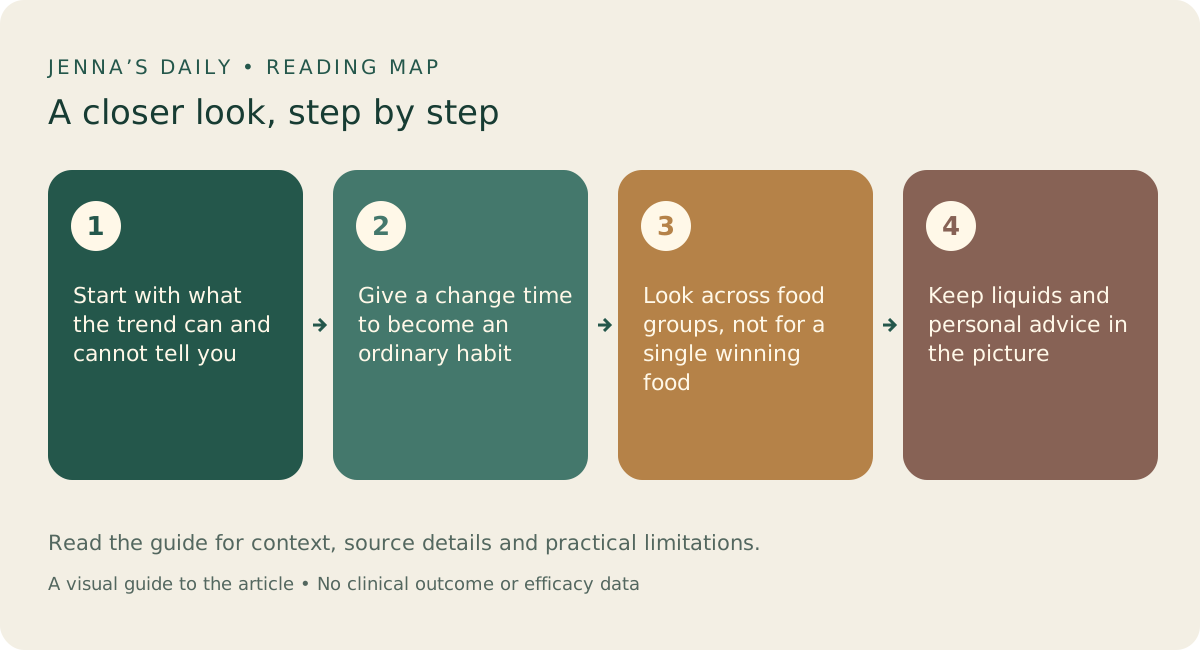
Look across food groups, not for a single winning food
NIDDK lists whole grains, legumes, fruits, vegetables and nuts as fiber sources. You can build variety around foods that suit your preferences and circumstances. An ingredient being popular online does not make it compulsory, and you do not need to eat a peel you dislike to participate in a more balanced food routine.
If you want to compare amounts, check the stated portion and the nutrition label rather than ranking foods from a photograph. A cup, a spoonful and a whole package are different amounts. Our separate fiber-per-serving guide explains the arithmetic without turning a label number into a personal target.
Keep liquids and personal advice in the picture
NIDDK advises drinking liquids to help fiber work and discussing the appropriate amount with a health care professional. Use any existing fluid restriction or individual care instructions when making changes. A universal online water target is not a substitute for that advice.
Persistent symptoms or uncertainty about a medical condition deserve an individual conversation. Record the foods you changed and the questions you want to ask, rather than adding several supplements to troubleshoot on your own. If you use a fiber supplement, its actual preparation directions and warnings remain a separate task.
Sources & further reading
- The facts about fiber: What Stanford Medicine experts want you to know ↗
- Fibermaxxing: Can You Have Too Much Fiber? ↗
- Eating, Diet, & Nutrition for Constipation ↗
Manufacturer information, when cited, is a commercial source. It does not establish that a finished product is clinically effective.