
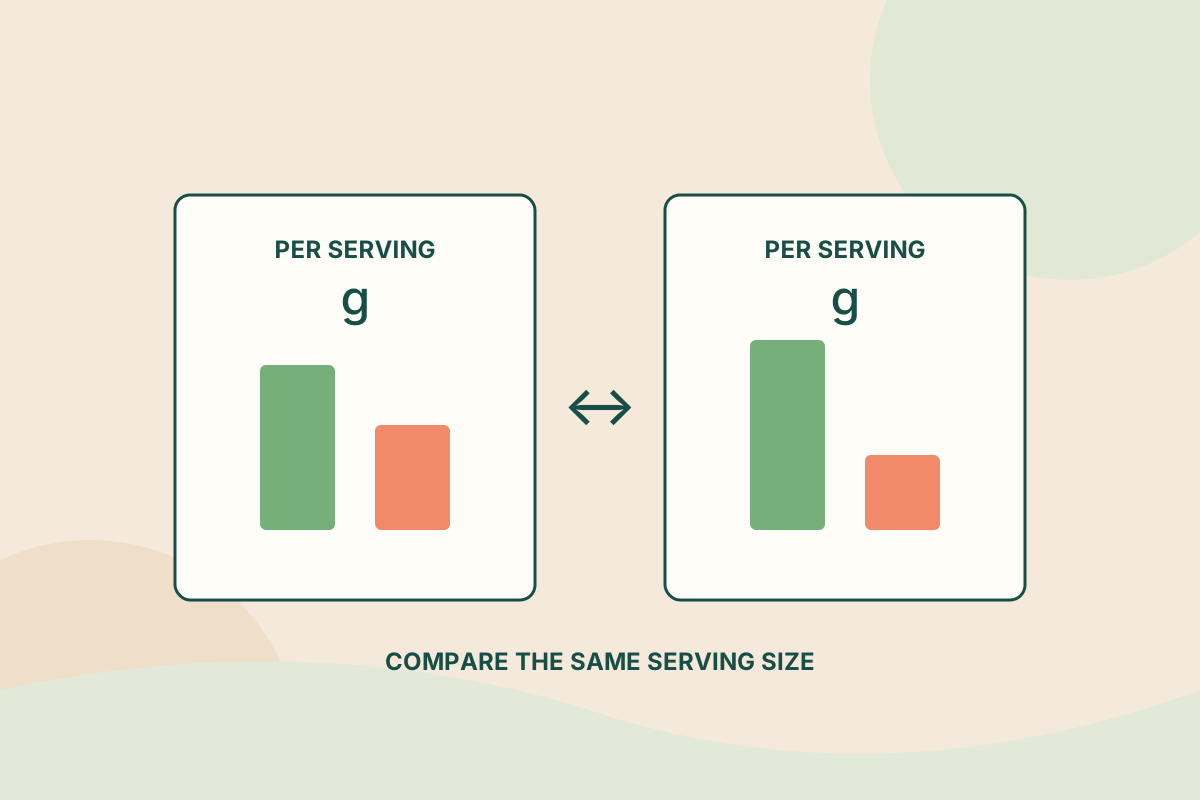
Put two fiber supplements side by side and the biggest number on the front may tell you the least. Before ordering, find the grams of dietary fiber in a labeled serving, count the servings you would receive, and compare the delivered price. This guide includes affiliate advertising. Jenna’s Daily may earn a commission if you buy through a marked link.
Step 1: Find the dietary fiber line
Turn the package over and start with Supplement Facts. Copy the Serving Size and then find Dietary Fiber. Record the amount for the full labeled serving. A label that declares 3 grams per 2 capsules lists 3 grams for the pair.
If a front label shows a blend weight, read what that number describes. A blend can include ingredients besides dietary fiber. For example, a hypothetical 1,000 mg blend weighs 1 gram in total. That figure alone gives you no confirmed grams of dietary fiber.
Normalize units before doing arithmetic
Use grams for both options. Divide a declared amount in milligrams by 1,000 to convert it to grams. Only do that for a number that actually describes dietary fiber. If the panel shows a blend amount or a list of ingredients but you cannot verify the dietary fiber amount, leave the fiber cell blank.
Considering a capsule product? The seller lists Villora in capsule form. Its marked affiliate card opens the seller’s product information. Ask for a readable Supplement Facts panel for the package you would receive if you cannot find one. We have verified the seller’s format description. The complete current label and the declared dietary fiber per serving remain unverified in our review.
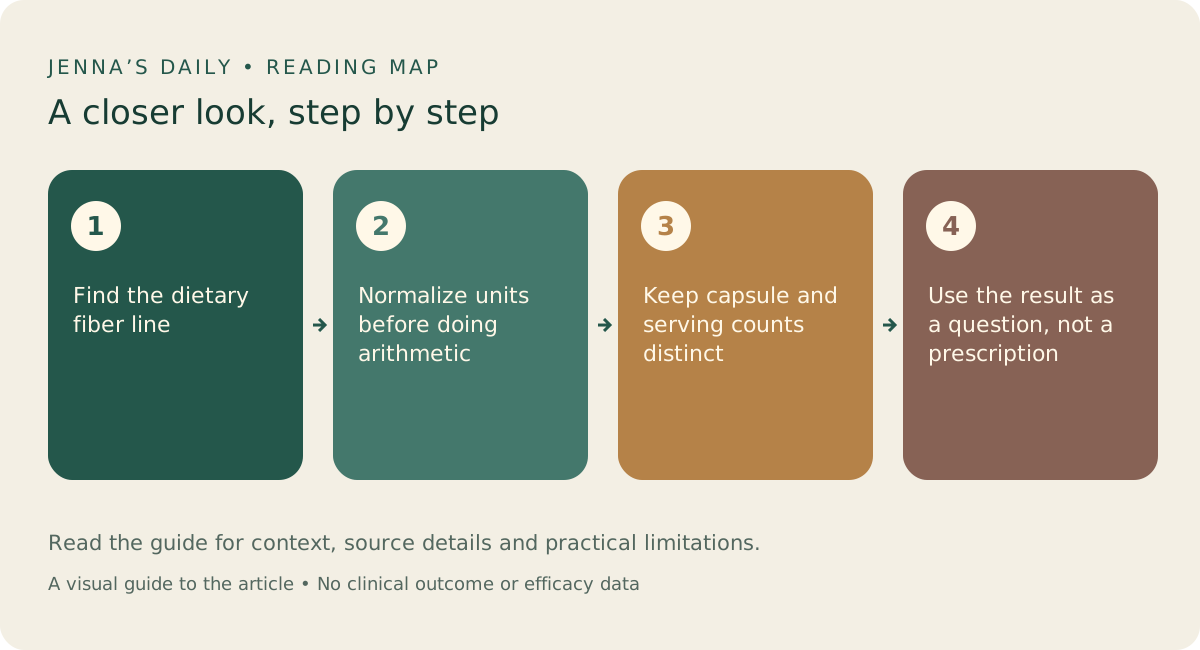
Step 2: Count the servings you would receive
Use the Servings Per Container field when the label lists it. Multiply it by the number of containers in your actual order. If the package gives an exact unit count and the serving has an exact unit count, you can calculate it. A hypothetical bottle of 80 capsules with 2 capsules per serving contains 40 servings.
Confirm the same package is shown on the label and in the cart. If the size or number of bottles is unclear, ask the seller before comparing totals.
Step 3: Compare the delivered price
Include shipping and applicable taxes, then divide that total by the labeled servings in the order. If both labels disclose dietary fiber per serving, you can also compare the price per gram of declared fiber. Multiply servings by grams per serving, then divide the delivered price by that total.
| Record for the actual order | Option A | Option B |
|---|---|---|
| Serving size on the label | ________ | ________ |
| Dietary fiber grams per labeled serving | ________ | ________ |
| Labeled servings in the order | ________ | ________ |
| Checkout total with delivery and taxes | ________ | ________ |
| Checkout total divided by labeled servings | ________ | ________ |
| Checkout total divided by declared fiber grams in the order | ________ | ________ |
- If a seller cannot confirm the fiber amount, you can still compare total price and price per serving when the serving count is clear. Leave price per gram blank.
- Read the complete ingredient list, directions and warnings before ordering. FDA advises discussing supplements with a healthcare professional. Bring the label if you have questions about whether a supplement fits your situation.
A cost calculation with a clear limit
Imagine Option A costs $32 delivered and has 40 servings at 2 grams of dietary fiber per serving. That is $0.80 per serving and $0.40 per gram of declared dietary fiber. Option B costs $36 delivered and has 30 servings at 4 grams per serving. That is $1.20 per serving and $0.30 per gram. Both are fictional products and prices.
Option A costs less today and per labeled serving. Option B costs less per gram of declared fiber. Those figures answer different shopping questions. Use them alongside the ingredient list and directions to decide whether either package belongs on your shortlist.
Sources & further reading
- FDA: Dietary Supplement Labeling Guide, Chapter IV ↗
- FDA: FDA 101 — Dietary Supplements ↗
- Villora: Seller product presentation, consulted for capsule format ↗
Manufacturer information, when cited, is a commercial source. It does not establish that a finished product is clinically effective.